
What is PVC?
Polyvinyl chloride, universally known as PVC or vinyl, is the world’s third most produced synthetic polymer after polyethylene and polypropylene. Chemically, PVC is built from repeating vinyl chloride monomer (VCM) units, giving it a backbone that is roughly 57% chlorine by weight. That single fact shapes almost everything about how PVC is made, how it is used, and — crucially for this article — how it must be recycled.
PVC comes in two broad families. Rigid PVC (uPVC) contains no plasticisers and is used for pipes, window profiles, doors, siding and rigid packaging. Flexible PVC is softened with plasticisers — historically phthalates — and appears in flooring, cables, roofing membranes, hoses, inflatable products and medical devices. The same base resin can therefore produce a drinking-water pipe that lasts a century and a stretchy medical tube, which is an enormous advantage for design but a serious challenge for recycling.
PVC carries resin identification code 3 inside the triangle symbol. Because it accounts for a large share of long-life construction plastics, Europe alone uses roughly five million tonnes of PVC every year, with the building and construction sector absorbing about 70% of that volume. The stock of PVC already installed in European buildings is enormous, and a growing share of it is now reaching the end of its first service life, which is exactly why plastic recycling specialists have been investing heavily in vinyl-specific infrastructure.
Why PVC recycling is challenging
If PVC were simply another thermoplastic, it could be melted and remoulded like HDPE recycling lines routinely do. In practice, three intertwined issues make PVC recycling more demanding than almost any other commodity polymer.
The first issue is chlorine. When PVC is heated above roughly 180 °C, it begins to release hydrogen chloride gas (HCl), which is corrosive to extruders and dangerous for operators. HCl release also discolours the melt, so recyclers must run at tightly controlled temperatures and use stabiliser systems designed specifically for chlorinated polymers. The same chlorine content makes PVC incompatible with the general polyolefin recycling stream — a single PVC bottle in a PET bale can scorch and ruin an entire batch of recycled PET.
The second issue is additives. Flexible PVC can contain 20–50% plasticiser by weight, plus heat stabilisers, impact modifiers, fillers and pigments. Over the decades, some of those additives included substances that are now restricted or banned: lead and cadmium stabilisers, short-chain chlorinated paraffins, and phthalates such as DEHP, DBP, BBP and DIBP. Legacy PVC arriving at today’s sorting plants may still contain these legacy substances, and recyclers must decide whether and how the resulting regrind can legally re-enter new products.
The third issue is heterogeneity. A mixed post-consumer load of rigid PVC might include white window frames, grey pipes, coloured profiles, compounded siding and multi-layer products with foamed cores. Each compound has its own formulation, and blending them indiscriminately produces inconsistent regrind. Quality recyclers therefore invest in near-infrared (NIR) sorting, density separation, colour sorting and, increasingly, AI-driven optical lines to build homogeneous input streams.
Sources of PVC for recycling

Roughly seven out of every ten tonnes of PVC ever produced ended up in the construction sector, which is also where today’s recycling volumes come from. The dominant sources are post-consumer window profiles, pipes and flooring, joined by post-industrial offcuts from converters.
Window profiles are the poster child of PVC recycling. European windows installed in the 1980s and 1990s are now being replaced en masse for energy-efficiency reasons, and the old frames are a near-ideal feedstock: a well-defined rigid compound, usually white, available in large volumes through organised demolition and window-installer take-back schemes such as Rewindo in Germany, Recovinyl across the EU and national partners of VinylPlus.
Pipes and fittings — from drinking water, sewage and cable protection applications — are another high-volume stream. Because pipes are engineered for long service life, most pipes currently being recycled were installed between the 1960s and 1990s, so recyclers must assume the possibility of legacy lead stabilisers.
Flooring, including contract vinyl and luxury vinyl tile (LVT), represents a large but more difficult flexible-PVC stream. Programmes such as AgPR in Germany and Recofloor in the UK collect installation offcuts and, increasingly, uplifted post-consumer flooring.
Cables are a specialised stream. The PVC jacket is stripped from the copper or aluminium conductor during granulation, separated by density, and returned as a flexible regrind. Packaging — rigid PVC trays, blisters and shrink films — is a comparatively small fraction in Europe today, because the PET and polyolefin industries have displaced PVC from most packaging segments. Automotive PVC (dashboards, underbody coatings, wire harnesses) rounds out the picture.
Whatever the source, the commercial reality is the same: consistent, well-sorted feedstock commands a premium, and brokers such as Plastic Trader or odzysk.pro play an important role in matching generators with the recyclers best equipped to process each grade.
Resin code 3 and how to identify PVC
The resin identification code “3” inside the chasing-arrows triangle, sometimes accompanied by the letters “PVC” or “V”, marks PVC products. Visually, PVC often has a slightly bluish-white tint in its natural state, feels denser than polyethylene, and sinks in water (its density is roughly 1.38 g/cm³, well above 1.0). A classic laboratory identification is the Beilstein test: a copper wire dipped in the sample and held in a flame turns green because of chlorine, instantly distinguishing PVC from polyolefins.
Modern sorting lines, however, rely almost entirely on NIR spectroscopy, which reads the characteristic C–Cl absorbance bands and separates PVC flakes from PE, PP, PET and PS at line speeds of several tonnes per hour.
Mechanical PVC recycling

Mechanical recycling is by far the dominant route for end-of-life PVC in Europe today. The workflow is conceptually similar to other polymers but fine-tuned for chlorinated chemistry.
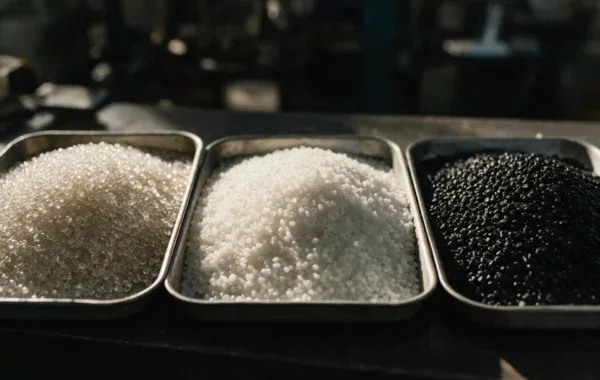
Incoming material is first coarsely shredded, then passed through magnetic and eddy-current separators to remove ferrous metals, aluminium and copper residues. Window frames are typically de-gasketed to remove EPDM or silicone seals and steel reinforcements. The cleaned fraction is granulated to a uniform flake size, washed in warm alkaline or neutral water to remove dust, dirt and surface contaminants, dried, and then either used directly as regrind or re-compounded and pelletised.
The recompounding step is where recyclers add fresh stabilisers, sometimes additional impact modifiers, and — for window profiles — encapsulate the regrind in a virgin outer layer via co-extrusion. This co-extrusion architecture, pioneered by major European profile producers, is the reason a 100% recycled-core window profile can still meet the same weathering and colour-fastness standards as a fully virgin product.
Mechanical recycling preserves most of the polymer’s molecular weight, has low energy consumption (typically 0.5–1.5 kWh per kilogram of regrind) and a carbon footprint around 70–90% lower than virgin PVC. Its limitations are equally clear: it cannot remove legacy additives, cannot cope with heavily mixed or contaminated streams, and produces a regrind whose colour drifts towards grey after multiple loops.
Solvent-based recycling (Vinyloop, Texiloop and successors)
To handle composites and flexible PVC that mechanical lines struggle with, the industry developed solvent-based, or “dissolution”, recycling. The best-known implementation was Vinyloop, operated by Solvay and Ferrari at Ferrara, Italy, from 2002. In the Vinyloop process, shredded PVC composite waste — for example coated fabrics, tarpaulins or cable waste — was dissolved in a selective solvent (methyl ethyl ketone with additives), filtered to remove insoluble fibres, metals and fillers, and then precipitated as a clean PVC compound by controlled steam injection. A parallel line, Texiloop, targeted technical textiles.
Vinyloop produced a high-quality recompound that was visually and mechanically indistinguishable from virgin, but the plant was closed in 2018. The decisive factor was the REACH restriction on DEHP, the plasticiser present in much of its feedstock; recovering PVC that still contained DEHP became legally and economically untenable for the operator.
The Vinyloop story did not end dissolution recycling — it redirected it. Successor technologies, including projects under the Horizon Europe umbrella and private ventures in France, Germany and the Netherlands, are developing next-generation solvent processes that use greener solvents, operate at lower temperatures, and specifically target legacy-plasticiser removal rather than retention. The commercial case is now oriented toward extracting phthalates and lead compounds during dissolution, delivering a recompound that complies with current REACH limits.
Feedstock and chemical recycling of PVC
Chemical, or feedstock, recycling breaks the polymer back into smaller molecules that can re-enter the petrochemical value chain. For PVC, the central chemical event is dehydrochlorination — the removal of hydrogen chloride.
In a typical process, PVC waste is heated in a controlled reactor, where the C–Cl bonds cleave first and release HCl gas. The HCl is captured, neutralised and can either be reused directly (for example to make fresh vinyl chloride monomer via the ethylene/oxychlorination route) or sold as industrial hydrochloric acid. The remaining dechlorinated hydrocarbon residue can be gasified, pyrolysed or co-processed in blast furnaces as a reducing agent, as practised in Japanese steel mills.
Pilot and demonstration plants in Europe are combining dehydrochlorination with downstream pyrolysis to produce pyrolysis oil and carbon black from the dechlorinated residue. The attraction is clear: chemical recycling accepts mixed, dirty, heavily additivated PVC that mechanical routes reject, and it destroys legacy substances rather than concentrating them. The challenges are capital intensity, the need for very clean HCl off-gas management, and an energy balance that only closes favourably at industrial scale.
VinylPlus programme achievements
European vinyl recycling is unusually well organised for a plastics segment, and the reason is VinylPlus. Launched in 2011 as the successor to Vinyl 2010, VinylPlus is the voluntary sustainable development commitment of the European PVC industry, co-signed by resin producers, converters, stabiliser manufacturers and plasticiser suppliers.
Its central commitment is quantitative. VinylPlus reports recycling volumes audited annually through the Recovinyl scheme. In 2023, VinylPlus reported more than 800,000 tonnes of PVC recycled per year within the programme’s scope, up from roughly 260,000 tonnes in 2010. The programme’s roadmap targets 900,000 tonnes by 2025 and one million tonnes by 2030, on a path to what the industry calls “PVC circularity”.
Beyond volume, VinylPlus has delivered the voluntary phase-out of lead-based stabilisers in the EU-28 (achieved by the end of 2015), a controlled-loop system for legacy additives, the VinylPlus Product Label for building products and, more recently, a Supplier Certificate that extends sustainability criteria up the value chain.
Applications of recycled PVC

Recycled PVC is not a marginal material — it is a working, specified ingredient across the sectors that use PVC in the first place.
Window profiles are the flagship application. Modern profile systems routinely embed a recycled core sandwiched between two thin virgin skins, achieving up to 80% recycled content in the overall profile while meeting every thermal, mechanical and weathering requirement of the virgin equivalent. Major brands including Rehau, Profine, Veka, Deceuninck and Aluplast have made recycled content a central marketing and regulatory argument.
Pipes are another major outlet. Sewer pipes, cable protection ducts and drainage systems can use multi-layer constructions with recycled middle layers. The European pipe standard EN 13476 explicitly provides for recycled-content structured-wall pipes.
Flooring uses recycled PVC in backing layers and acoustic underlays. Cables recycle their own flexible PVC back into non-critical cable applications, road cones, safety mats, shoe soles and garden hoses. Roofing membranes, fencing, traffic management products and noise barriers round out the portfolio, with recycled content typically in the 30–100% range depending on the specification.
Regulatory landscape
The regulatory environment is moving fast, and PVC sits at the intersection of several major files.
REACH is the foundational instrument. Restrictions under REACH Annex XVII have progressively banned or limited the most problematic PVC additives: lead compounds (restriction adopted 2023, transitional periods still running), cadmium, four phthalates (DEHP, DBP, BBP, DIBP) in most articles since 2020, and an ongoing dossier on PVC and its additives as a whole that ECHA has been preparing for the European Commission.
The Packaging and Packaging Waste Regulation (PPWR), adopted in 2024 and entering into force from 2026, introduces recycled-content targets for plastic packaging and restricts certain problematic packaging formats. PVC packaging is effectively being designed out of food contact applications under the PPWR’s restrictions on substances of concern.
The Construction Products Regulation revision, the Eco-design for Sustainable Products Regulation (ESPR) and the Waste Framework Directive together create the pull for recycled-content mandates in building products, which is where the PVC industry generates and consumes most of its recyclate. National measures — the Dutch Besluit bodemkwaliteit, the German Ersatzbaustoffverordnung, the French AGEC law — add further layers of requirement.
Challenges: contamination, plasticizer migration and legacy substances
Three technical challenges dominate the daily work of a PVC recycler.
Contamination is the bread-and-butter problem. Non-PVC polymers entering a PVC line (notably PET and polyolefins) degrade the regrind and can cause processing defects. Inorganic contamination — sand, cement, metal fines — accelerates tool wear. Recyclers defend themselves through multi-stage sorting, friction washing and, for the most demanding specifications, optical flake sorting after granulation.
Plasticiser migration affects flexible PVC. Over years of service, plasticisers diffuse out of the matrix, which changes the regrind’s properties relative to the original compound. Worse, where the migrated plasticiser is a restricted phthalate, the surface of the regrind may need to be treated or the material confined to applications shielded from human contact.
Legacy substances — lead stabilisers, cadmium pigments, short-chain chlorinated paraffins, SVHC-listed phthalates — are the single biggest policy question facing the sector. The pragmatic European answer has been the “controlled-loop” concept under REACH’s derogations: legacy substances are permitted to circulate inside closed, traceable recycling loops (for example window frame to window frame) as long as they are encapsulated inside virgin layers and not released to consumers, while being simultaneously phased out of new formulations.
The future: PVC in the circular economy
PVC’s position in the circular economy is being re-written in real time. Three trends will shape the next decade.
First, recycled content mandates in construction products will push demand for high-quality regrind well above today’s supply. Capacity additions are under way across Europe, including dedicated window-frame and flooring lines.
Second, chemical recycling will move from pilot to commercial scale for the fraction that mechanical recycling cannot serve — composites, heavily additivated flexible PVC and legacy streams. Dehydrochlorination followed by downstream use of both the HCl and the hydrocarbon residue offers a genuinely circular route back to virgin-equivalent monomer.
Third, design for recycling will accelerate. Bio-attributed and recycled-attributed vinyl, single-polymer design of PVC articles, better marking and digital product passports under ESPR will all make end-of-life PVC easier to recover, sort and reprocess.
Whether PVC fully earns its circular-economy credentials will depend on the industry’s ability to deliver on all three fronts simultaneously — and on Europe’s regulators maintaining a framework that is demanding on legacy substances but pragmatic about the role of high-quality recyclate in low-carbon construction.
FAQ
Is PVC actually recyclable?
Yes. Mechanical recycling is well-established for rigid PVC (windows, pipes, profiles), and more than 800,000 tonnes of PVC are recycled every year within the VinylPlus programme in Europe. Flexible PVC and composites are increasingly handled by solvent-based or chemical routes.
Can PVC go in the household recycling bin?
In most European municipalities, no. PVC is not collected with PET bottles or polyolefin packaging because even small amounts contaminate those streams. End-of-life PVC products — windows, pipes, flooring — are collected through dedicated take-back schemes such as Rewindo, Recovinyl or Recofloor.
What is resin code 3?
Resin code 3, the triangle with “3” and usually the letters “PVC” or “V”, identifies polyvinyl chloride. It is used on PVC packaging, bottles and films so that sorters and consumers can distinguish PVC from the other six main plastic categories.
Why did Vinyloop close?
The Vinyloop solvent-recycling plant in Ferrara closed in 2018 after REACH restrictions on DEHP made it uneconomic to recycle feedstocks still containing that phthalate. The underlying dissolution technology is being revived in next-generation plants designed to extract, rather than retain, legacy plasticisers.
Does recycled PVC contain lead?
Some recyclate derived from pre-2015 window frames or pipes contains historic lead stabilisers at low levels. Under REACH, these legacy substances are allowed to circulate inside encapsulated, traceable closed loops — typically as the inner core of a co-extruded window profile — while lead-based stabilisers have been fully phased out of new PVC formulations in the EU since 2015.

Leave a Reply