
Polyethylene terephthalate — better known as PET — is the single most recycled plastic in the world. From mineral water bottles to polyester fleece jackets, PET moves through the economy in enormous volumes, and unlike most polymers it has the chemistry, the infrastructure and the regulatory support to be recycled back into itself, again and again. For brand owners, converters and waste managers, PET recycling is no longer a sustainability nice-to-have; it is a market reality shaped by binding EU rules, volatile virgin-resin prices and consumer expectations.
This guide walks through the complete lifecycle of PET recycling: what PET actually is, why it recycles better than almost any other plastic, how a modern bottle-to-bottle plant operates, what quality parameters matter on the trading floor, and how Europe is tracking against its 2025 and 2030 targets. Whether you source odzysk.pro — recyklat PET B2B for a new packaging line or manage curbside collection for a municipality, the fundamentals below apply.
What is PET?
PET, or polyethylene terephthalate, is a thermoplastic polyester produced by the polycondensation of purified terephthalic acid (PTA) and monoethylene glycol (MEG). It was patented in the 1940s by British chemists John Whinfield and James Dickson, originally for textile fibres — the polyester shirts in most wardrobes are chemically the same material as a soft-drink bottle. PET became the dominant beverage packaging polymer in the 1970s because of a unique combination of clarity, strength-to-weight ratio, barrier properties and low cost.
PET exists in two main physical forms. Amorphous PET (A-PET) is transparent and is used for bottles, thermoformed trays and films. Crystalline PET (C-PET) is opaque and heat-stable and is used in ovenable trays and engineering applications. The intrinsic viscosity, or IV, determines which form a resin is suitable for: textile-grade PET sits around IV 0.60–0.65 dL/g, while bottle-grade PET requires IV 0.72–0.82 dL/g to withstand stretch-blow moulding and internal CO₂ pressure.
Global PET production exceeds 30 million tonnes per year, with roughly two-thirds going into fibres and one-third into packaging. In Europe, packaging PET dominates the recycling conversation because it is collected separately, it is relatively clean, and it is concentrated in a product format — the drinks bottle — that consumers recognise and sort reliably.
Why PET is so recyclable
Not all plastics are created equal when it comes to circularity. PET has four characteristics that together make it the textbook case for closed-loop recycling.
First, PET is a polyester, not a polyolefin. Its ester linkages can be cleaved chemically (glycolysis, methanolysis, enzymatic depolymerisation) to recover the original monomers. This gives PET a chemical recycling route that polyethylene and polypropylene simply do not have.
Second, PET has a high melting point (around 250–260 °C) and a narrow processing window, which means it can be mechanically recycled multiple times without catastrophic chain scission, provided moisture and contamination are controlled. Each thermal history reduces IV slightly, but solid-state polycondensation (SSP) can rebuild molecular weight back to bottle-grade specifications.
Third, the dominant application — the single-serve beverage bottle — is a near-mono-material product. A typical PET water bottle is 95 %+ PET by weight, with only a PP or HDPE cap and a BOPP or PET label. Compare this to a yoghurt pot with an aluminium lid, a paper sleeve and a printed PP body, and the recyclability gap becomes obvious.
Fourth, PET is heavy enough to sink in water (density ~1.38 g/cm³), while its most common contaminants — PE caps, PP labels, polystyrene — float. This simple density difference enables float-sink separation at industrial scale with very high purity.
These properties are the reason PET sits at the heart of almost every European plastic recycling overview and why regulators picked PET beverage bottles as the first packaging format to carry mandatory recycled-content minimums.
The PET recycling process
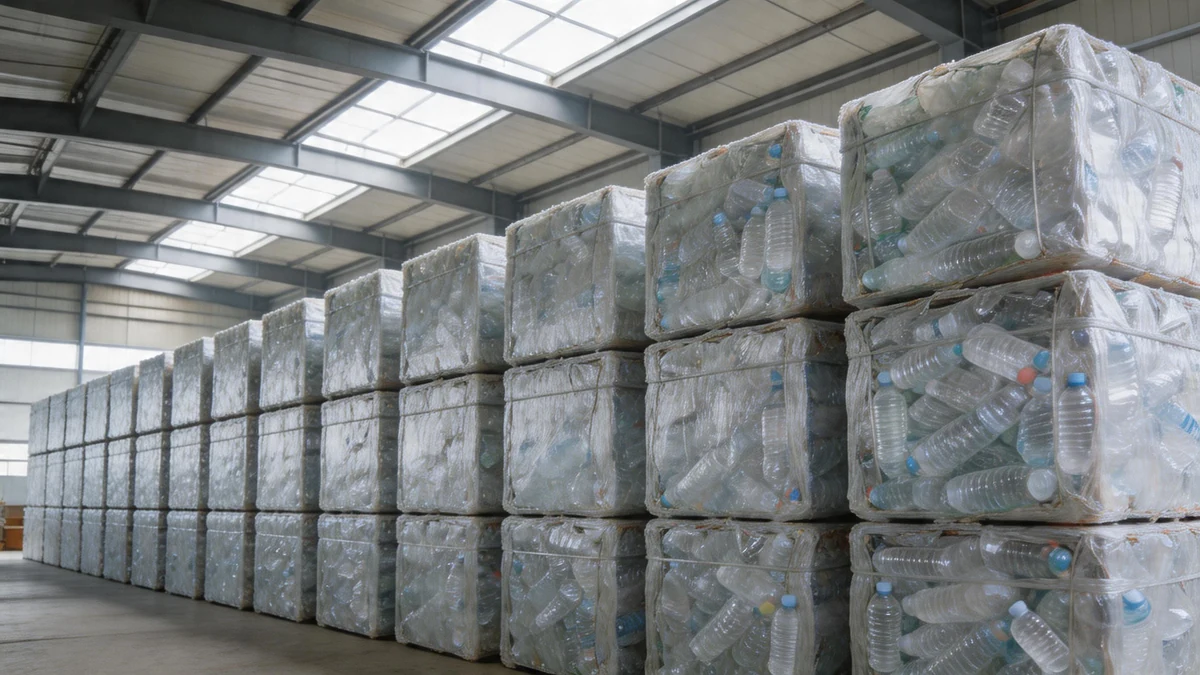
A modern PET recycling plant is a continuous operation that turns post-consumer bottles into food-contact-grade flakes or pellets in roughly 24 hours. The line is usually broken into five stages.
1. Collection
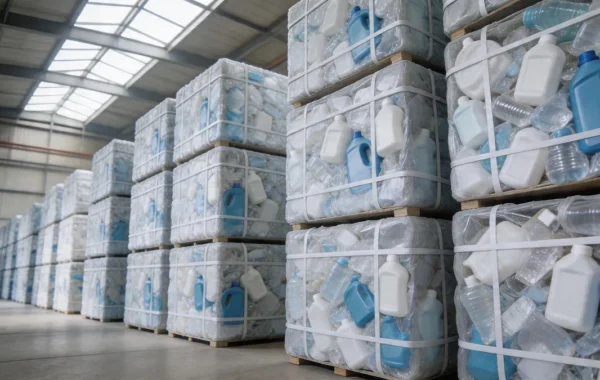
Input bales arrive from three main streams: deposit-return schemes (DRS), kerbside commingled collection, and commercial-and-industrial (C&I) collection. Deposit-return bales are the gold standard — purity above 98 %, very low moisture, minimal coloured or opaque content. Kerbside bales are cheaper but require more aggressive sorting because they carry trays, non-bottle PET and mis-sorted polyolefins.
2. Sorting
Bales are broken open and fed across near-infrared (NIR) optical sorters that identify and eject non-PET polymers, PVC (a critical contaminant even at ppm levels), and — in advanced lines — separate clear, light-blue, green and opaque PET into distinct fractions. Magnetic and eddy-current separators remove ferrous and non-ferrous metals. Manual picking cabins still exist but are increasingly replaced by AI vision systems.
3. Hot wash
Sorted bottles are ground into 8–12 mm flakes and washed in a caustic solution at 80–90 °C. The hot wash does three jobs simultaneously: it dissolves adhesives from labels, hydrolyses the surface of any PLA or PVC contamination so it can be rinsed away, and reduces the bacterial load to levels acceptable for food-contact applications downstream. A friction washer and multiple rinse stages follow.
4. Flaking and drying
Washed flakes pass through float-sink tanks where PET sinks and olefin caps and labels float off. The clean flakes are dried to moisture below 0.02 % — critical, because residual water will hydrolyse PET chains in the subsequent melt phase and collapse the IV. At this point the material can already be sold as rPET flake to fibre spinners and strapping producers.
5. Pelletizing and decontamination
For food-contact and bottle-grade output, flakes are extruded into amorphous pellets and then processed in a solid-state polycondensation (SSP) reactor. SSP runs at 200–220 °C under vacuum or nitrogen for 8–16 hours; it simultaneously rebuilds IV from around 0.70 up to 0.78–0.82 dL/g and evaporates residual migrants (limonene from orange juice, acetaldehyde, any inadvertent contaminants) to the parts-per-billion levels required by EFSA.
Bottle-to-bottle recycling
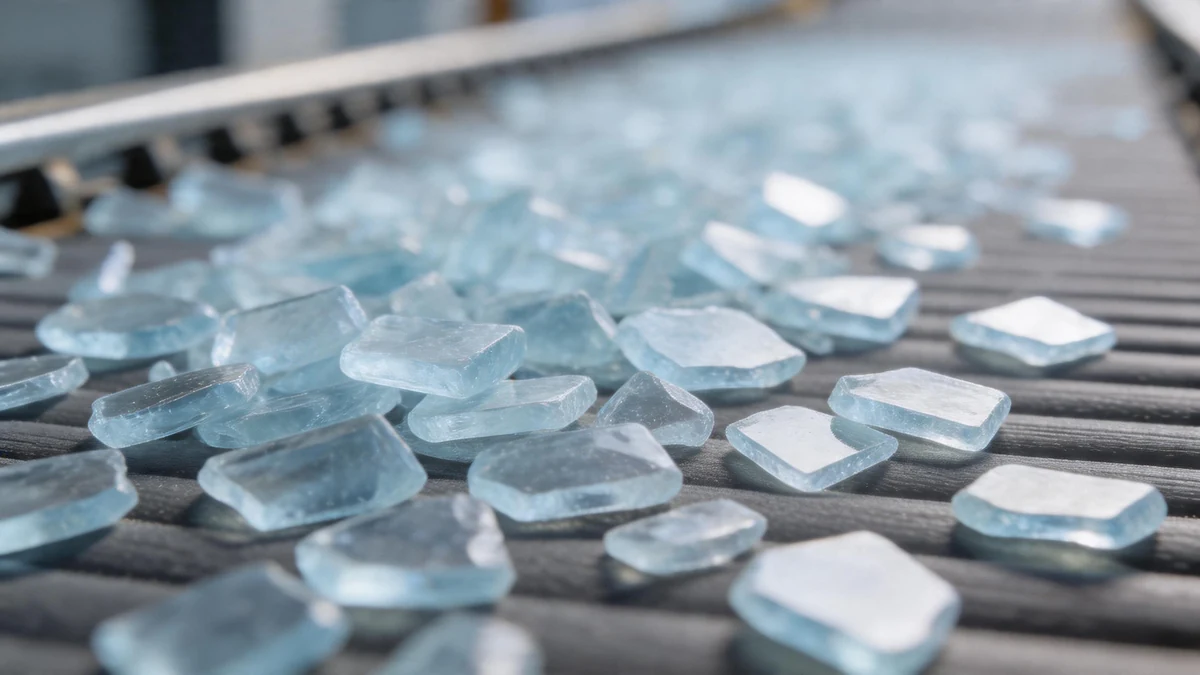
Bottle-to-bottle (B2B) is the closed loop that keeps PET in its highest-value application. A used bottle becomes an rPET pellet that becomes a new bottle, potentially many times over. This loop is what PPWR regulators, brand sustainability teams and the trading desks at Plastic Trader all watch most closely, because it is where volume, price and regulation converge.
B2B works because PET is one of very few plastics approved by EFSA for direct food contact after mechanical recycling, provided the decontamination process is validated. The European Commission Regulation (EU) 2022/1616 defines the legal framework: each recycler must operate an authorised process, demonstrate migration limits, and log batch traceability. As of 2024 there are more than 200 authorised PET decontamination processes in the EU register.
The economics of B2B depend on three variables: the virgin PET price (linked to paraxylene and ultimately oil), the green premium brand owners are willing to pay for rPET, and the effective yield of the recycling plant. When virgin PET trades at €1,100/t and food-grade rPET commands €1,300–1,500/t, the loop is strongly profitable; when virgin collapses below €900/t, as happened briefly in 2023–2024, rPET economics tighten and regulatory mandates become the main demand driver.
Food-grade rPET and EFSA certification
Not all rPET is food-grade. The distinction matters commercially because food-grade material trades at a significant premium and is the only rPET that can be used in beverage bottles, dairy packaging or ready-meal trays that touch the product.
To qualify as food-grade, an rPET producer must operate a decontamination process that has been positively evaluated by EFSA (European Food Safety Authority) under Regulation (EU) 2022/1616. The evaluation uses the so-called challenge test: the recycler spikes virgin PET flakes with surrogate contaminants (toluene, chlorobenzene, chloroform, benzophenone, methyl stearate) at defined concentrations, runs them through the full recycling process, and measures residual concentrations in the output. If the process removes the surrogates below the threshold of concern (typically 0.0025 µg/kg body weight/day for infant exposure), it is authorised.
Most commercial food-grade PET lines combine a hot caustic wash with high-temperature vacuum SSP; some newer processes use supercritical CO₂ or solvent-based purification. The authorisation is process-specific, not producer-specific, so a recycler running multiple lines needs multiple authorisations.
Applications of recycled PET
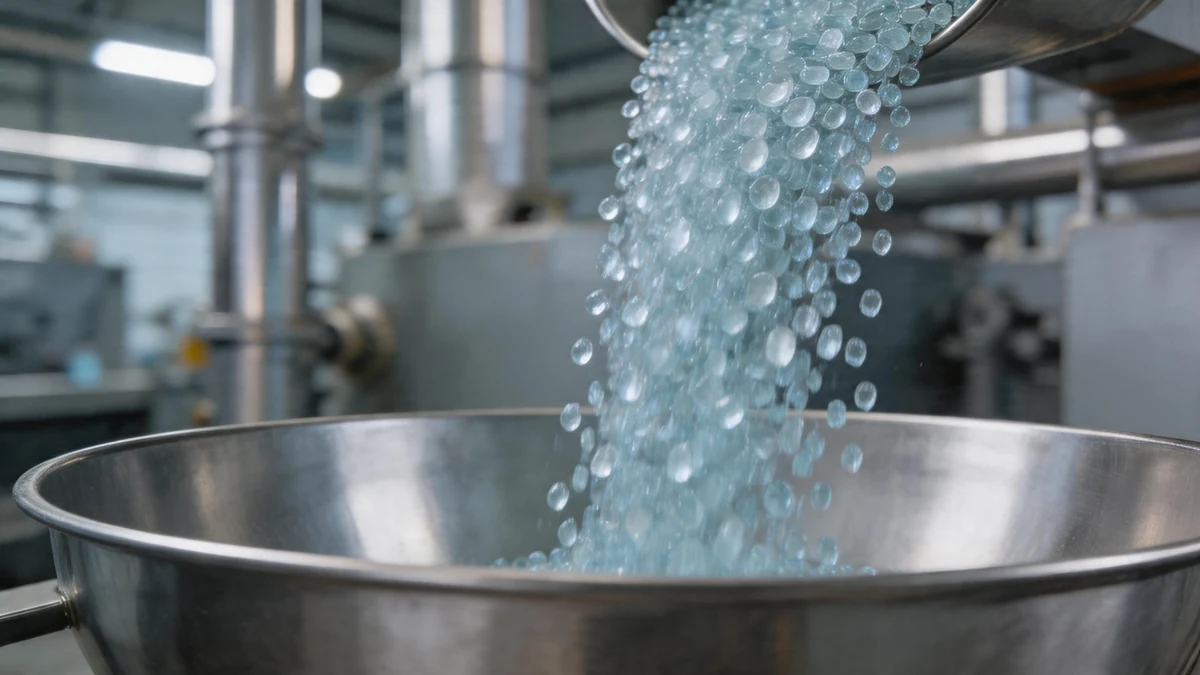
rPET is sold into four main end markets, each with distinct specifications and prices.
Textiles remain the largest volume outlet globally, absorbing roughly 60 % of mechanically recycled PET. rPET fibre goes into fleece, non-wovens, carpet, automotive interior fabrics and the polyester staple used in fast fashion. Textile-grade rPET tolerates lower IV (around 0.60 dL/g) and higher colour variation, which makes it the natural home for mixed-colour bottle fractions.
New bottles consume a growing share — in Western Europe, bottle-to-bottle now represents 30–40 % of rPET volumes and is climbing fast as PPWR deadlines approach. This segment demands the highest quality: clear colour, IV 0.78–0.82, and full EFSA authorisation.
Strapping and sheet applications use thicker-gauge rPET for industrial packaging, thermoforming trays and blister packs. IV requirements sit between textile and bottle grade (0.70–0.78), and colour specifications are relaxed, which makes this a good home for light-blue and light-green fractions.
Engineering compounds use rPET — often glass-reinforced — in electrical housings, automotive parts and construction profiles. Volumes are small but prices are high.
Quality parameters (IV, colour, contamination)
On the trading desk, rPET is defined by a short list of measurable parameters. The table below summarises the typical grade structure.
| Grade | IV (dL/g) | Colour b* | PVC (ppm) | Moisture | Typical application |
|---|---|---|---|---|---|
| Food-grade pellet | 0.78–0.82 | ≤ 1.5 | < 5 | ≤ 0.02 % | Bottle-to-bottle |
| Clear hot-washed flake | 0.70–0.76 | ≤ 2.5 | < 20 | ≤ 0.8 % | Sheet, strapping, fibre |
| Light-blue flake | 0.70–0.76 | 5–10 | < 20 | ≤ 0.8 % | Fibre, non-food bottles |
| Mixed-colour flake | 0.65–0.75 | > 10 | < 50 | ≤ 1.0 % | Fibre, strapping |
Intrinsic viscosity is measured in a capillary viscometer in phenol/tetrachloroethane solvent and correlates directly with molecular weight. Colour is reported on the CIE L*a*b* scale, where b* measures yellow-blue and is the single most important aesthetic metric for a clear bottle. PVC contamination is tracked to ppm levels because PVC decomposes to HCl at PET processing temperatures, corroding extruders and yellowing the melt.
Challenges: trays, coloured PET and shrink sleeves
Despite PET’s favourable chemistry, the real-world waste stream is messier than the bottle-to-bottle narrative suggests. Three problem categories dominate plant managers’ complaint lists.
PET trays (thermoformed punnets for fruit, meat, ready meals) use a different resin specification than bottles — lower IV, often multilayer with EVOH or PE barrier, frequently with PE or PP liners. When trays end up in the bottle stream they depress average IV and introduce contaminants. Some European plants now run dedicated tray lines; others reject trays at the bale-sort stage.
Coloured PET — particularly the opaque white PET used for UHT milk — cannot be decolourised and dilutes the value of the clear fraction. Several brand owners have committed to phasing out opaque white PET by 2025.
Full-body shrink sleeves made of PVC or PETG blind NIR sorters because the sleeve covers the bottle wall that the scanner reads. PET bottles with full-body sleeves are routinely mis-sorted into the reject stream, representing a direct yield loss. The RecyClass and APR guidelines both now classify full-body PVC sleeves as design-for-recycling non-compliant.
Solving these issues is not just a recycler’s problem — it is a design problem that circles back to the principles of the circular economy, where responsibility for end-of-life performance sits with the packaging designer from the first sketch.
PET recycling rates in Europe
Europe leads the world on PET collection and recycling, but the headline numbers hide wide regional variation. The EU average collection rate for PET beverage bottles sits around 55 %, but countries with well-run deposit-return schemes routinely hit 90 %+. Germany, Lithuania, Estonia, Finland, Norway and the Netherlands all exceed 90 % collection; Southern European markets without DRS sit in the 30–50 % range.
The Packaging and Packaging Waste Regulation (PPWR) sets the pace for the next decade. Mandatory recycled content in PET beverage bottles is fixed at 25 % by 2025 and rises to 30 % by 2030; the 2040 target under discussion reaches 65 % for contact-sensitive applications. The Single-Use Plastics Directive (SUPD) separately requires a 90 % separate collection rate for single-use plastic bottles by 2029, with an interim 77 % target by 2025.
These targets have pulled forward billions of euros of investment in B2B capacity. European rPET food-grade capacity grew from roughly 1.2 million tonnes in 2020 to an expected 2.8 million tonnes by 2026, with new plants announced in Spain, France, Germany, Poland, Italy and the UK. Demand is forecast to outstrip supply through at least 2027, keeping a structural premium on food-grade rPET.
FAQ
Can PET be recycled infinitely?
In principle yes, but mechanical recycling causes slight IV loss at each cycle. With SSP boosting, most studies find that PET can survive 5–10 mechanical cycles before becoming uneconomic for bottle use; after that it typically cascades into fibre or strapping. Chemical recycling (depolymerisation back to monomer) removes this limit entirely and is scaling up in Europe, with commercial plants operated by Eastman, Loop Industries, Carbios and others.
Why is clear PET worth more than coloured PET?
Because clear rPET can be used to make any colour of new packaging, while coloured rPET is locked into its own colour or darker. Clear PET therefore addresses a much larger addressable market, commands a premium, and flows preferentially into bottle-to-bottle loops.
What does “food-grade rPET” actually mean?
It means the rPET was produced by a recycling process that EFSA has positively evaluated under Regulation (EU) 2022/1616, with documented batch traceability and migration testing. The material is legally suitable for direct food contact. Non-food-grade rPET is chemically similar but lacks the authorisation dossier and cannot legally touch food.
Are PET trays recycled the same way as PET bottles?
Not yet, at scale. Trays have different IV, frequent multilayer construction and a much higher rate of label and adhesive contamination. Some European plants now operate dedicated tray-to-tray lines, but most kerbside trays still go to fibre or are rejected. PPWR and design-for-recycling guidelines are pushing the industry toward mono-material PET trays that can be recycled with bottles.
How does deposit-return improve PET recycling?
Deposit-return schemes deliver clean, single-stream PET bottles with collection rates above 90 % and bale purity above 98 %. The combination of high yield and low contamination lifts the economic value of the material by €100–200 per tonne versus kerbside equivalents and is the single most effective policy lever for reaching PPWR targets.

Leave a Reply