
High-density polyethylene — better known as HDPE, or resin identification code 2 — is the workhorse of the rigid plastic packaging world. Every time you pick up a milk jug, a detergent bottle, a shampoo container, a crate of beverages or a large industrial drum, you are almost certainly holding HDPE. It is tough, chemically resistant, food-safe in virgin form, and — crucially for sustainability — one of the most readily recyclable thermoplastics on the planet. This comprehensive guide explains how HDPE recycling works, from kerbside bin to finished pellet, and what buyers, processors and brand owners need to know about grades, prices, applications and regulatory barriers in Europe.
What is HDPE?
HDPE stands for high-density polyethylene, a thermoplastic polymer produced from the monomer ethylene (C₂H₄) via catalytic polymerisation — typically using Ziegler-Natta, Phillips (chromium) or metallocene catalysts at relatively low pressures. The result is a largely linear molecular structure with very few side branches, which allows the polymer chains to pack tightly together. That tight packing is precisely what gives HDPE its “high density” and distinguishes it from LDPE (low-density polyethylene), which has many long side branches and a looser, softer structure.
Commercially, HDPE has been produced since the mid-1950s, and today global production exceeds 50 million tonnes per year. In Europe it is one of the top three commodity plastics by volume, alongside PP and PET. It carries the recycling triangle with the number “2” inside — the SPI resin identification code established in 1988 — and is universally accepted by municipal recycling systems across the EU, UK, Norway and Switzerland.
The appeal of HDPE is a combination of four factors: it is cheap (virgin HDPE typically trades at €1,100–1,400/t in Europe), it is mechanically robust, it is chemically inert to most acids, bases, salts and alcohols, and it can be processed by almost every polymer conversion method — blow moulding, injection moulding, extrusion, thermoforming, rotomoulding and film casting.
Properties of HDPE
Understanding the physical and chemical properties of HDPE is essential to understanding why it recycles so well and what the recycled resin can — and cannot — be used for.
Density
HDPE has a density of 0.941–0.965 g/cm³, placing it firmly above water (1.00 g/cm³) but below PET (1.38 g/cm³), PVC (1.38 g/cm³) and PS (1.05 g/cm³). This density window is the single most important property for recyclers, because it enables the sink-float separation technique described later in this article. The practical rule is simple: HDPE and PP float in water, almost every other common packaging polymer sinks.
Melt flow index (MFI)
Melt flow index — measured in grams per 10 minutes at 190 °C under a 2.16 kg load — characterises how easily molten HDPE flows. Commercial HDPE grades span an MFI range of roughly 0.3 to 10 g/10 min, and the figure strongly predicts the end application:
- MFI 0.3–0.6: pressure pipe (PE100), large blow-moulded drums, IBCs
- MFI 0.7–1.5: bottle blow moulding (milk, detergent)
- MFI 2–8: injection moulding of caps, crates, pallets
- MFI 8–10+: thin-wall injection, some film grades
A recycler that wants to sell pellets into the bottle market must hit a narrow MFI window, and this is why feedstock segregation matters so much.
Mechanical and thermal properties
- Tensile strength at yield: 22–32 MPa
- Elongation at break: 100–1,200 %
- Flexural modulus: 800–1,500 MPa
- Vicat softening point: 120–130 °C
- Melting point: 130–137 °C
- Service temperature: −50 °C to +80 °C (short peaks to 120 °C)
Chemical resistance
HDPE is outstandingly resistant to acids, alkalis, salt solutions, alcohols and most polar solvents. It is attacked only by strong oxidising acids (concentrated nitric, fuming sulphuric), some aromatic and chlorinated hydrocarbons at elevated temperature, and by prolonged UV exposure without stabilisers. This chemical inertness is why HDPE dominates the chemical drum, jerrycan and IBC market.
Sources of post-consumer and post-industrial HDPE
Recycled HDPE (rHDPE) feedstock enters the value chain through two distinct streams that determine both the quality and the commercial value of the output.
Post-consumer HDPE (PCR)
Post-consumer HDPE is material that has reached an end-user — typically a household — and been collected through kerbside, bring-bank or deposit systems. It is dominated by:
- Natural (uncoloured) milk bottles — the premium fraction, known in the trade as “natural HDPE”
- Mixed-coloured HDPE bottles — detergent, shampoo, cleaning products, motor oil
- HDPE caps and closures from PET bottles (separated during PET recycling)
- Small HDPE tubs and pots (margarine, ice cream)
- HDPE crates, buckets and pallets from commercial streams
In Europe, natural HDPE milk-bottle bales are the most valuable post-consumer fraction, typically priced at €650–900/t at the bale stage and producing food-grade-eligible regrind and pellets.
Post-industrial HDPE (PIR)
Post-industrial — also called post-manufacture or “engineering” — HDPE comes from factory scrap: purges, sprues, runners, off-spec parts, cut-offs and production overruns. Because it has never been used, it is clean, single-grade, uncontaminated and often comes with full material datasheets. PIR HDPE typically sells at €900–1,200/t as regrind and can approach virgin-equivalent technical performance. Pipe manufacturers, blow moulders and rotomoulders are the principal sources.
Resin code 2 explained
The triangular “chasing arrows” logo with the digit 2 inside — and the letters “HDPE” or “PE-HD” beneath — was introduced by the Society of the Plastics Industry (SPI) in 1988 and is now codified in ISO 11469 and ASTM D7611. It has nothing to do with whether an object is actually recycled; it simply identifies the polymer so sorters and consumers can route it correctly.
Resin code 2 covers all HDPE variants: homopolymer, copolymer (with small amounts of butene, hexene or octene comonomer), and bimodal grades used for pressure pipe. Importantly, PE-HD and HDPE are the same material — the European convention (DIN/ISO) writes “PE-HD” while the North American convention writes “HDPE”.
The HDPE recycling process
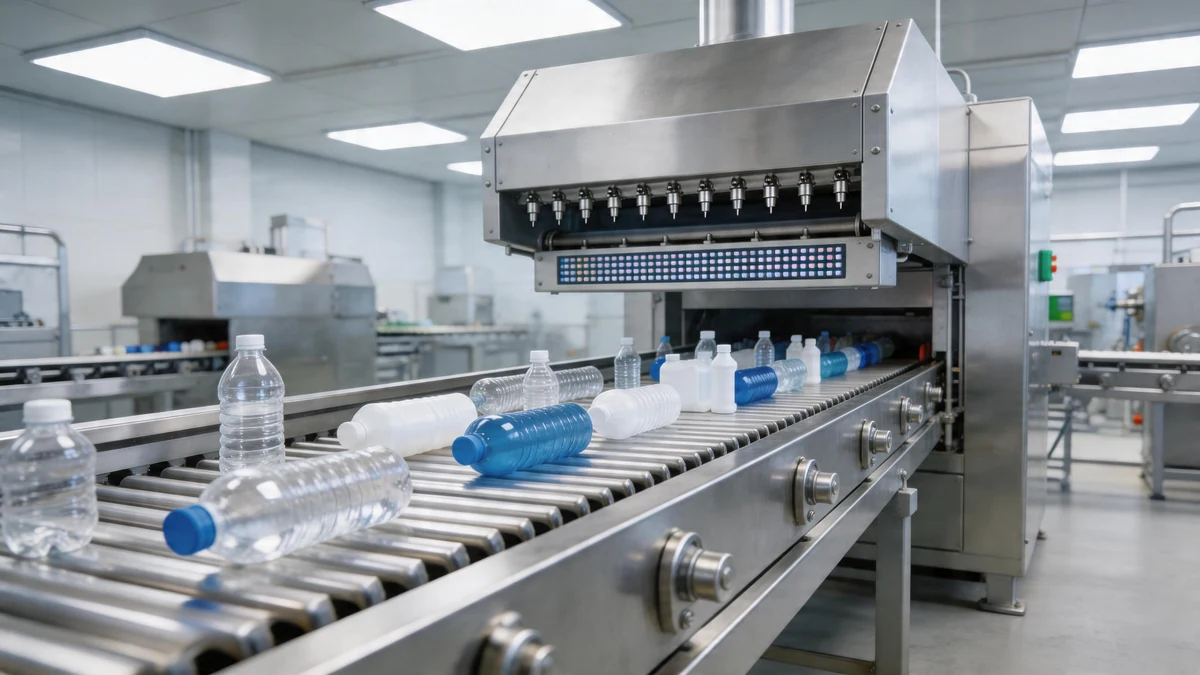
Mechanical recycling of HDPE bottles is one of the most mature plastic recycling processes in existence. A modern European bottle-to-pellet line — operated by companies such as Veolia, Suez, Morssinkhof, Viridor, Paprec or Alpla — typically runs at 1–3 t/hour and includes the following steps.
1. Collection and baling
Mixed rigid plastic collected at kerbside is sent to a Materials Recovery Facility (MRF), where optical (NIR) sorters, ballistic separators and manual QC pickers isolate HDPE bottles. Natural and coloured fractions are usually baled separately. Bale specifications follow EN 643 principles or the more specific Plastics Recyclers Europe quality standards.
2. Bale breaking and pre-sort
Bales are opened and passed over a second NIR sort to eject residual PET, PVC, PP and paper labels. PVC is the critical contaminant — even 50 ppm of PVC in HDPE can cause acidic degradation and black specks during extrusion.
3. Bottle/cap separation
Closures are usually PP (≥95 % of beverage caps today) or a different HDPE grade. They are liberated during grinding and separated downstream by the sink-float tank, but some lines pre-deck whole bottles to remove PP shrink sleeves and labels beforehand.
4. Granulation (wet grinding)
Bottles are reduced to flakes of 8–12 mm in wet granulators. Water both cools the knives and pre-washes the flakes.
5. Sink-float separation
This is the heart of the process. Flakes are fed into a float tank filled with water. HDPE and PP flakes (density <1.0 g/cm³) float and are skimmed off the top; PET, PVC, aluminium foil seals, stones and sinkers fall to the bottom and are removed. Two or three stages of sink-float may be cascaded for high-purity output.
6. Hot caustic wash
Floated flakes are washed in a 1–3 % sodium hydroxide solution at 75–85 °C to remove glue, residual product, oils and labels, followed by friction washers and rinse tanks.
7. Drying
Mechanical centrifuge drying brings residual moisture below 0.5 %, followed by a thermal dryer to reach <0.1 %.
8. Extrusion and pelletising
Dry flakes are fed into a single- or twin-screw extruder equipped with melt filtration (typically 80–120 µm screens) and vacuum degassing to remove VOCs. The filtered melt is pelletised — either strand-cut or underwater — into uniform 3 mm lentil-shaped pellets.
9. Homogenisation and QC
Pellets are conveyed to large silos (30–50 t) for homogenisation, then tested for MFI, density, colour (L*a*b*), moisture, ash, and volatile organics before being bagged or loaded into silo trucks.
Forms of recycled HDPE
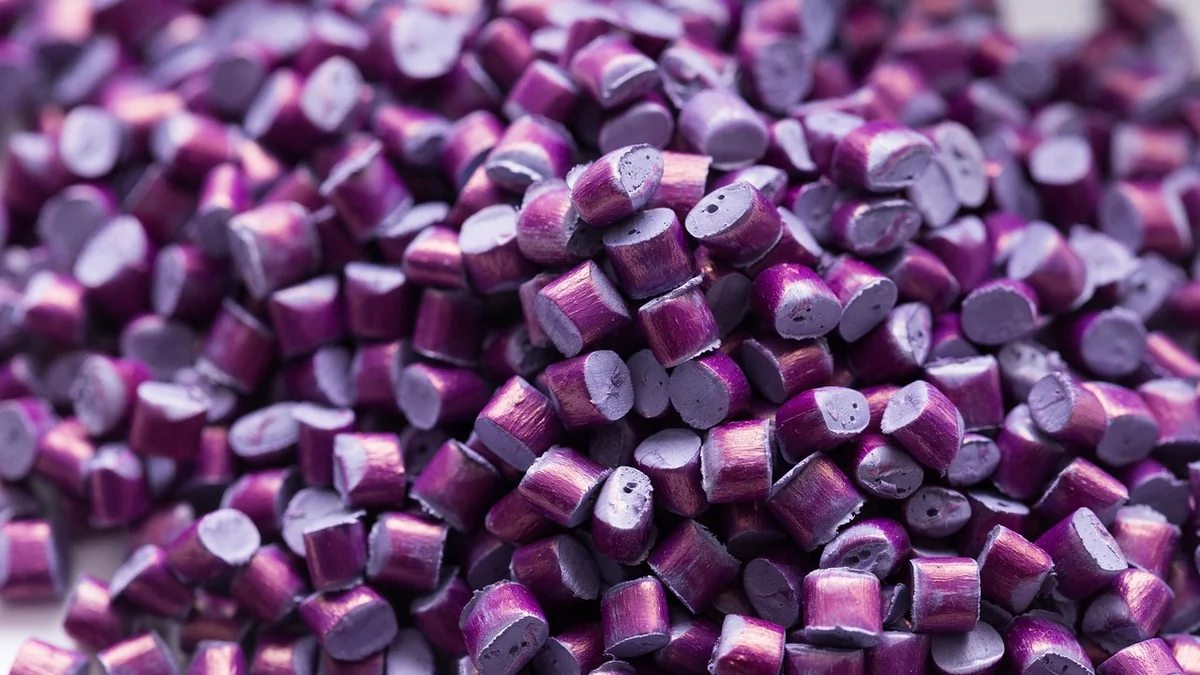
rHDPE is sold in three main physical forms, each priced and specified differently.
Regrind (flake)
Washed, dried and optionally colour-sorted flake, not yet re-extruded. Regrind is cheaper (typically €700–1,000/t in Europe in 2025), faster to produce and retains more of the original molecular weight, but it is harder to dose accurately and cannot be food-contact certified. Regrind is the staple feedstock for thick-wall injection moulding (crates, pallets), plastic lumber and pipe non-pressure applications. Check B2B suppliers such as odzysk.pro — B2B recyklat HDPE or Plastic Trader for specifications.
Pellets (regranulate)
Fully re-extruded, filtered and pelletised. Pellets cost more (€900–1,300/t) but are fully homogeneous, can be dosed into any moulding machine alongside virgin resin and are eligible for food-contact certification through EFSA-approved processes. Pellets are subdivided into:
- Natural (milky-white to light grey): highest value, made from natural milk-bottle feedstock.
- Light coloured (mint green, light blue): mid value.
- Mixed coloured (grey/brown/black): produced from the coloured bottle fraction; lowest value but largest volume.
Agglomerate
A niche product from HDPE film and IBC liner scrap — densified but not re-pelletised. Cheapest form, used mainly in drainage pipe and lumber compounds.
Quality grades and MFI specifications
European rHDPE is commercially classified using three overlapping systems: the Plastics Recyclers Europe RecyClass grades, the EN 15343/15347 traceability standards, and bilateral supplier specifications. A typical commercial data sheet for premium rHDPE blow-moulding pellets looks like:
- Density: 0.955 ± 0.003 g/cm³
- MFI (190 °C / 2.16 kg): 0.8 ± 0.2 g/10 min
- Moisture: <0.05 %
- Ash content: <0.3 %
- Black specks >200 µm: <5 per kg
- Odour: ≤3 on VDA 270 scale
- Colour: natural / blue-grey / black (customer specified)
- Filtration level: 80 µm
Injection-moulding grades shift the MFI target to 4–8 g/10 min, and pipe-grade rHDPE (where permitted — typically non-pressure only) demands tighter particle and gel control with ISO 4427 compliance checks.
Applications of recycled HDPE

rHDPE is one of the most flexible recyclates available to European converters, and the application spectrum has broadened considerably in the last decade as brand owners chase 25 % and 30 % recycled content commitments under the EU Packaging and Packaging Waste Regulation (PPWR).
Non-pressure pipe
Corrugated drainage pipe (EN 13476), cable protection ducts, land drainage and geotechnical pipes all accept high loadings of rHDPE — often 50–100 %. This is the single largest outlet for mixed-colour regrind in Europe.
Crates, pallets and bins
Logistics crates (milk crates, bread crates, beverage trays), wheelie bins and industrial pallets routinely run 50–100 % rHDPE. Black bins in particular are tolerant of mixed-colour, highly contaminated feedstock.
Plastic lumber and street furniture
Decking, fencing, benches, bollards and playground equipment manufactured from extruded rHDPE are replacing tropical hardwoods and treated timber. These applications absorb the lowest grade, most coloured rHDPE — a crucial market for the recycling industry.
Non-food bottles and containers
Detergent bottles, shampoo bottles, motor oil containers, garden chemical bottles and industrial cleaning jerrycans increasingly carry 30–100 % rHDPE. Coloured layers or full-body colour hide any off-shade from the recyclate.
Industrial drums and IBCs
Reconditioned and new 200 L drums, 20 L jerrycans and 1000 L IBC inner bottles are strong markets for high-quality PIR and natural PCR rHDPE.
Rigid films and geomembranes
Multilayer blown film with a rHDPE core and virgin skins is growing rapidly, as are HDPE geomembranes for landfill capping and pond lining.
Food-contact rHDPE and regulatory barriers
Unlike PET, where bottle-to-bottle PET recycling with food-contact approval is routine, food-contact rHDPE remains a regulatory bottleneck. Under EU Regulation 2022/1616 (replacing 282/2008), every recycling process placing rHDPE on the EU market for food contact must be individually authorised by EFSA. As of early 2026, only a handful of HDPE decontamination technologies have received favourable EFSA opinions — these are based on super-clean extrusion with high-vacuum degassing, solid-state post-condensation or dedicated deep-cleaning reactors.
The core problem is that HDPE, unlike PET, does not crystallise tightly enough to lock contaminants out of the polymer matrix during service. Small molecules — fragrances, flavour compounds, traces of household chemicals — can diffuse in and are harder to remove. As a result, the vast majority of rHDPE in 2026 still goes to non-food applications.
Challenges in HDPE recycling
Colour mixing and carbon black detection
Conventional NIR sorters cannot “see” carbon-black pigmented HDPE because black pigments absorb the near-infrared signal. This has historically sent millions of tonnes of black HDPE to landfill or incineration. New generations of mid-infrared and hyperspectral sensors (e.g. Tomra Autosort Black, Unisensor Powersort) now detect black plastics reliably, and the EU PPWR actively incentivises non-detectable-black-free design for recyclability.
Caps and closure contamination
PP caps in an HDPE stream (or vice versa) are tolerable up to 3–5 % but above that shift the MFI, weaken weld lines and reduce ESCR (environmental stress-crack resistance). Tethered-cap regulations under the Single-Use Plastics Directive, in force since July 2024, are changing the cap landscape and require new sink-float and wind-shifter tuning.
Labels, sleeves and adhesives
Full-body PVC shrink sleeves on HDPE bottles are a recycler’s nightmare — they cannot be separated by sink-float because both sink together, and their PVC degrades the HDPE during extrusion. Paper labels with alkali-soluble adhesive are the preferred design, and RecyClass “Design for Recycling” guidelines now explicitly score this.
Degradation and cascading
Each extrusion cycle reduces HDPE molecular weight through chain scission, typically shifting MFI up by 5–15 % per cycle. After three to five cycles, material is usually cascaded down to plastic lumber or drainage pipe where MFI is less critical.
HDPE recycling rates in Europe
According to Plastics Europe and Eurostat data published in 2025 (covering 2023), Europe generated roughly 5.1 million tonnes of post-consumer HDPE packaging waste. Of this, approximately 46 % was collected for recycling, with the remainder split between energy recovery (39 %) and landfill (15 %). Actual mechanical recycling yield — after process losses of 15–25 % — stood at around 1.7 million tonnes of rHDPE output.
Country-level performance varies widely: Germany, the Netherlands, Belgium, Austria and Scandinavia achieve HDPE recycling rates above 55 %, while Southern and South-Eastern Europe lag at 25–35 %. The EU PPWR sets a binding recycled-content target of 35 % for non-PET contact-sensitive rigid packaging by 2030 and 65 % by 2040, which is expected to drive rHDPE demand growth of 7–9 % per year throughout the decade.
Typical 2025–2026 European plastic recycling market prices for rHDPE (CIF Rotterdam, monthly averages):
- Natural rHDPE pellets (food-grade-eligible): €1,150–1,350/t
- Natural rHDPE pellets (technical): €950–1,150/t
- Mixed-colour rHDPE pellets: €750–950/t
- Black rHDPE pellets: €650–850/t
- HDPE regrind, natural: €800–1,000/t
- HDPE regrind, mixed: €700–850/t
Frequently Asked Questions
Is all HDPE recyclable?
In principle yes — HDPE is a thermoplastic and can be melted and reprocessed many times. In practice, recyclability depends on colour (carbon-black is still challenging for many MRFs), size (items <40 mm escape most sorting equipment), contamination (food residues, fuel, motor oil) and multilayer construction. Clean, single-material, light-coloured HDPE bottles ≥250 ml are essentially always recycled when placed in household kerbside systems.
What is the difference between HDPE and LDPE recycling?
HDPE is a rigid, linear polymer mostly used for bottles and crates; LDPE is a softer, branched polymer dominated by films and flexible packaging. Their densities overlap (LDPE 0.915–0.925, HDPE 0.94–0.97), so sink-float cannot separate them reliably — instead NIR sorting and form-factor separation are used. LDPE film recycling is a fundamentally different process, running through shredders, hot-wash, friction washing and pelletising with heavier focus on drying and de-inking.
Can recycled HDPE be used for food packaging?
Only if produced by an EFSA-approved recycling process under EU Regulation 2022/1616. As of 2026 this applies to a small number of commercial lines in Germany, Austria, Belgium, Italy and the UK. Most rHDPE on the European market is certified for technical, non-food or indirect-contact use only.
How many times can HDPE be recycled?
Mechanically, HDPE can typically survive 3–7 heat-history cycles before its properties degrade below useful specifications. However, “cascading” — moving each cycle to a less demanding application — means that HDPE molecules can stay in the materials economy for decades before ultimately being incinerated with energy recovery or, increasingly, chemically recycled back to feedstock.
What does resin code 2 on the bottom of a bottle mean?
It is the SPI/ISO 11469 identifier for high-density polyethylene. It tells sorters and consumers that the bottle is made of HDPE and should be placed in the rigid plastic recycling stream. It does not, by itself, guarantee that the specific item is recycled in your region — that depends on your local MRF and collection contract.
Conclusion
HDPE is arguably the textbook success story of European mechanical recycling. Its density, chemical stability and dominance in simple rigid packaging make it uniquely amenable to high-yield, low-energy recycling, and the process from collection to pellet is well-understood and scalable. The remaining challenges — food-contact approval, black plastics detection, PVC cross-contamination and cap-material heterogeneity — are being actively solved by legislation, design-for-recycling standards and advanced sorting technology. For buyers, processors and brand owners, sourcing quality rHDPE from trusted suppliers like odzysk.pro — B2B recyklat HDPE or Plastic Trader is a reliable route to meeting recycled-content targets without compromising product performance.


Leave a Reply