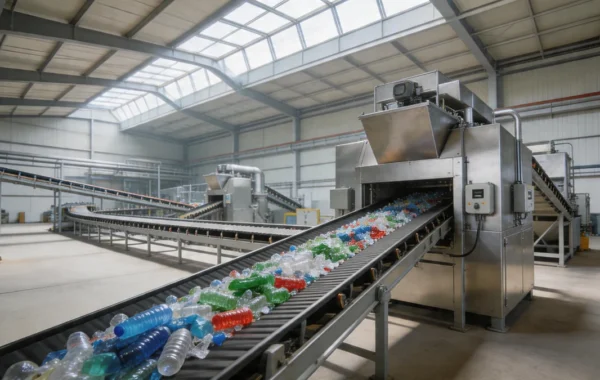
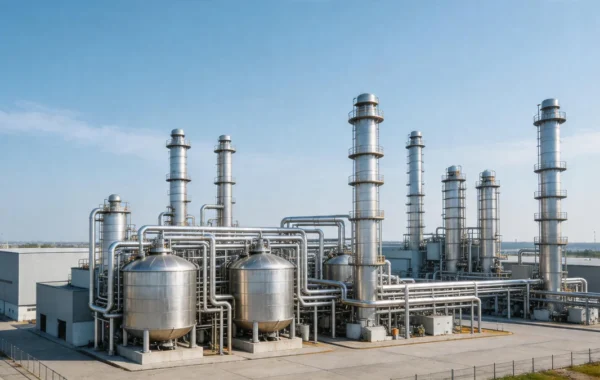
No technology in recycling has a wider gap between what has been announced and what is running than chemical recycling. As of October 2025, around 65 projects with a combined capacity of some 2.8 million tonnes of plastic waste per year had been announced or were under construction in Europe, with pyrolysis alone accounting for a potential 1.68 million tonnes. Installed pyrolysis input capacity actually in operation is roughly 150,000 tonnes a year, with more than 300,000 tonnes under construction or in commissioning. Roughly one twentieth of what was announced is running.
What chemical recycling is meant to solve
Mechanical recycling does not change the chemistry of a plastic. Waste is sorted, washed, shredded and melted back into pellets. The polymer chains survive, though they shorten slightly with each cycle, which limits how many times a given molecule can go round.
Chemical recycling breaks the polymer down into simpler compounds. In pyrolysis the output is an oil that can substitute for fossil feedstock in producing new polymers. In principle this allows material to be reprocessed repeatedly without quality loss, and — more importantly — allows mixed and contaminated waste to be treated at all. That is the material mechanical lines reject and that, until now, was largely exported.
The catch is energy. Breaking polymer chains requires putting back much of the energy that formed them, so the environmental case depends heavily on where that energy comes from.
Why the announced capacity has not materialised
The gap between 2.8 million tonnes and 150,000 tonnes is not evidence of bad faith. It reflects two hard realities.
The first is technical: scaling from a pilot to a commercial line is unusually difficult in this technology. Feedstock variability that a pilot can absorb becomes an operational problem at scale, and the plants that have run continuously for years remain few.
The second is economic. Pyrolysis oil competes with naphtha. When naphtha is cheap, a plant that must collect, sort, dry and thermally crack mixed plastic waste has no cost advantage at all — only a regulatory and reputational one. That has been enough to fund pilots. It has not consistently been enough to fund commercial lines.
What has closed and what is still being built
Viridor shut its three Quantafuel chemical recycling plants across Scandinavia, stating that the sector was not commercially viable. Plastic Energy, a UK pioneer frequently cited as a leader in plastic waste pyrolysis, entered administration.
At the same time, capital is still being committed. Waste Plastic Upcycling has announced a facility at the Port of Rotterdam able to process 80,000 tonnes a year of post-consumer end-of-life plastic. The sector is not being abandoned so much as filtered: what survives tends to have access to cheap, stable feedstock and an offtaker willing to pay a premium over the fossil equivalent.
Two EU instruments, two different answers
Whether chemically recycled material should count towards recycled content targets was contested for years. Answers are now emerging, and they do not agree.
The draft implementing act under the Single-Use Plastics Directive, which secured Member State committee support on 6 February 2026, foresees the inclusion of chemically recycled material in PET beverage bottles under defined conditions. The act is on its way to adoption.
The draft EU-wide end-of-waste criteria for plastics, open for feedback until 26 January 2026, cover mechanical and physical recycling — processes retaining the polymer chains — and do not, at this stage, take chemical recycling into consideration.
So the same technology is recognised in one instrument and left out of another. For projects with a ten- to fifteen-year payback that inconsistency is not a footnote; it is a material risk.
What November changes
From 21 November 2026 the EU bans exports of plastic waste to non-OECD countries, with an estimated 500,000 to 800,000 tonnes a year needing local treatment. Most of it will be exactly the mixed, difficult material chemical recycling was designed for.
Whether that turns announcements into plants depends on the oil price and on whether brand owners pay a premium for lower-carbon polymer. Without that premium, an obligation to treat waste domestically leads to incineration rather than to pyrolysis — which would be a lawful outcome and a poor one.
Frequently asked questions
How much chemical recycling capacity is operating in Europe?
Installed pyrolysis input capacity in operation is around 150,000 tonnes a year, with over 300,000 tonnes under construction or in commissioning, against some 2.8 million tonnes announced across roughly 65 projects as of October 2025.
How does chemical recycling differ from mechanical recycling?
Mechanical recycling preserves the polymer chains: waste is sorted, washed, shredded and melted into pellets. Chemical recycling breaks the polymer into simpler compounds, such as pyrolysis oil, which can replace fossil feedstock in producing new polymers.
Does chemically recycled content count towards EU targets?
It depends on the instrument. The draft implementing act under the Single-Use Plastics Directive, supported on 6 February 2026, foresees its inclusion in PET bottles under conditions, while the draft end-of-waste criteria for plastics cover only mechanical and physical recycling.
Related reading: chemical recycling sets out the individual technologies in more depth, plastic recycling covers the mechanical route these plants are meant to complement, and the circular economy places both within the wider policy framework.
Sources: EUWID survey of announced European chemical recycling projects (October 2025); reports on the closure of Viridor’s Quantafuel plants and on Plastic Energy; Waste Plastic Upcycling plans for the Port of Rotterdam; European Commission answer to parliamentary question E-000567/2026; draft EU end-of-waste criteria for plastics; Regulation (EU) 2024/1157.