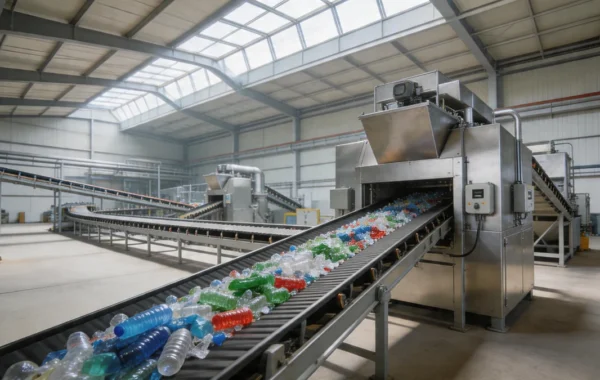
Since 2025 the Single-Use Plastics Directive has required PET beverage bottles placed on the EU market to contain 25% recycled plastic. The obligation is short, clear and, until recently, unaccompanied by any harmonised method for proving compliance. On 6 February 2026 the Commission secured the necessary support from Member States in the responsible comitology committee for rules on calculating and verifying that recycled content, and the draft act is on its way to adoption. Its most consequential provision is not the arithmetic: it is the inclusion, under defined conditions, of chemically recycled material.
Why a calculation method was needed
A target of 25% raises three questions that the directive itself does not answer. Twenty-five per cent of what — the bottle, the preform, the polymer, the batch? Averaged over what period and what population of bottles? And demonstrated how, to whom, with what documentation?
Left to national interpretation, those questions produce twenty-seven different compliance regimes for a product sold across borders in enormous volumes. A bottler operating in several Member States could be compliant in one and not in another with the identical product. That is the gap the implementing act closes.
The chemical recycling question
The draft rules foresee the inclusion of chemically recycled material under defined conditions, in addition to mechanically recycled plastic. That single sentence resolves a dispute that has run for most of a decade.
The argument against inclusion was that chemically recycled content usually reaches a product through mass balance allocation rather than as physically traceable material. A given bottle may contain no molecule that was ever in a used bottle; instead, a certified accounting system attributes a quantity of recycled feedstock to it. Critics see that as a paper exercise. Supporters point out that petrochemical crackers physically cannot segregate streams, so the alternative to allocation is excluding chemical recycling from every recycled content target permanently.
The draft resolves it pragmatically: chemically recycled content counts, but conditionally. Those conditions are what will determine whether the provision is a genuine incentive or a loophole, and they are the part worth reading closely when the final text appears.
An inconsistency across instruments
The same technology is treated differently elsewhere. The draft EU-wide end-of-waste criteria for plastics, open for public feedback until 26 January 2026, cover mechanical and physical recycling — processes retaining the polymer chains — and do not, at this stage, take chemical recycling into consideration.
So under one instrument chemically recycled material can count towards a bottle’s recycled content, while under another it does not qualify for the regime that would let it circulate as a product rather than as waste. Neither position is unreasonable in isolation. Together they make investment planning harder than it needs to be, in a sector where installed pyrolysis capacity — roughly 150,000 tonnes a year against some 2.8 million tonnes of announced projects — already reflects deep hesitancy.
The wider package
The PET bottle rules were part of the package the Commission announced in December 2025 to support plastics circularity. Alongside them came the draft end-of-waste criteria, separate customs codes distinguishing virgin from recycled polymers, a relaunch of the Circular Plastics Alliance and market monitoring. The Commission also announced a Circular Economy Act as a broader horizontal measure for 2026.
The customs code change deserves a mention of its own. Without separate codes, trade statistics cannot distinguish recycled from virgin polymer, which means nobody — including the Commission — can measure the flows the rest of the policy depends on. It is unglamorous and probably more useful than several higher-profile measures.
What to watch
Three things, once the act is adopted. The precise conditions attached to chemically recycled content. The verification burden placed on bottlers versus on resin suppliers. And whether the method allows averaging across production, which determines whether 25% is a floor for every bottle or a portfolio average.
One caution on language: the committee gave its support on 6 February 2026 and the act is on its way to adoption. It has not been adopted, and describing it as law would be premature.
Frequently asked questions
What recycled content must PET beverage bottles contain in the EU?
The Single-Use Plastics Directive requires 25% recycled plastic in PET beverage bottles from 2025. Rules on calculating and verifying that content secured Member State committee support on 6 February 2026 and are on their way to adoption.
Does chemically recycled plastic count towards the 25% target?
The draft implementing act foresees the inclusion of chemically recycled material under defined conditions, in addition to mechanically recycled plastic. The final conditions will determine how significant that inclusion is in practice.
Why is chemical recycling treated differently in different EU instruments?
The draft PET bottle rules would count chemically recycled content under conditions, while the draft end-of-waste criteria for plastics cover only mechanical and physical recycling. The two instruments answer different questions and currently reach different conclusions about the same technology.
What is mass balance allocation?
It is a certified accounting method that attributes a quantity of recycled feedstock to a product even where the material cannot be physically traced, which is typical where recycled and virgin streams are processed together in petrochemical plants.
Related reading: chemical recycling explains the technologies whose output this act would recognise, plastic recycling covers the mechanical route that supplies most recycled content today, and the circular economy places both inside the wider EU framework.
Sources: European Commission answer to parliamentary question E-000567/2026 on the implementing act concerning calculation and verification of recycled content in PET single-use beverage bottles; European Commission package on plastics circularity, December 2025 (IP/25/3151); draft EU end-of-waste criteria for plastics; EUWID survey of European chemical recycling projects (October 2025).