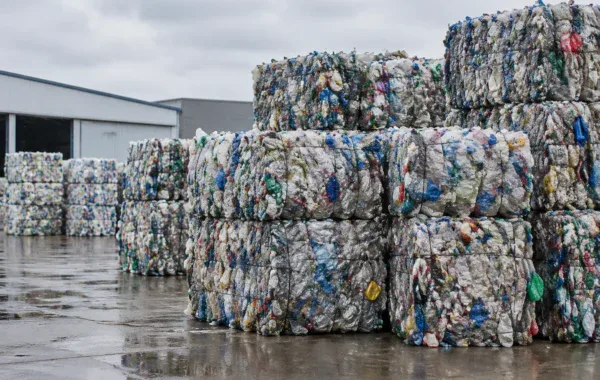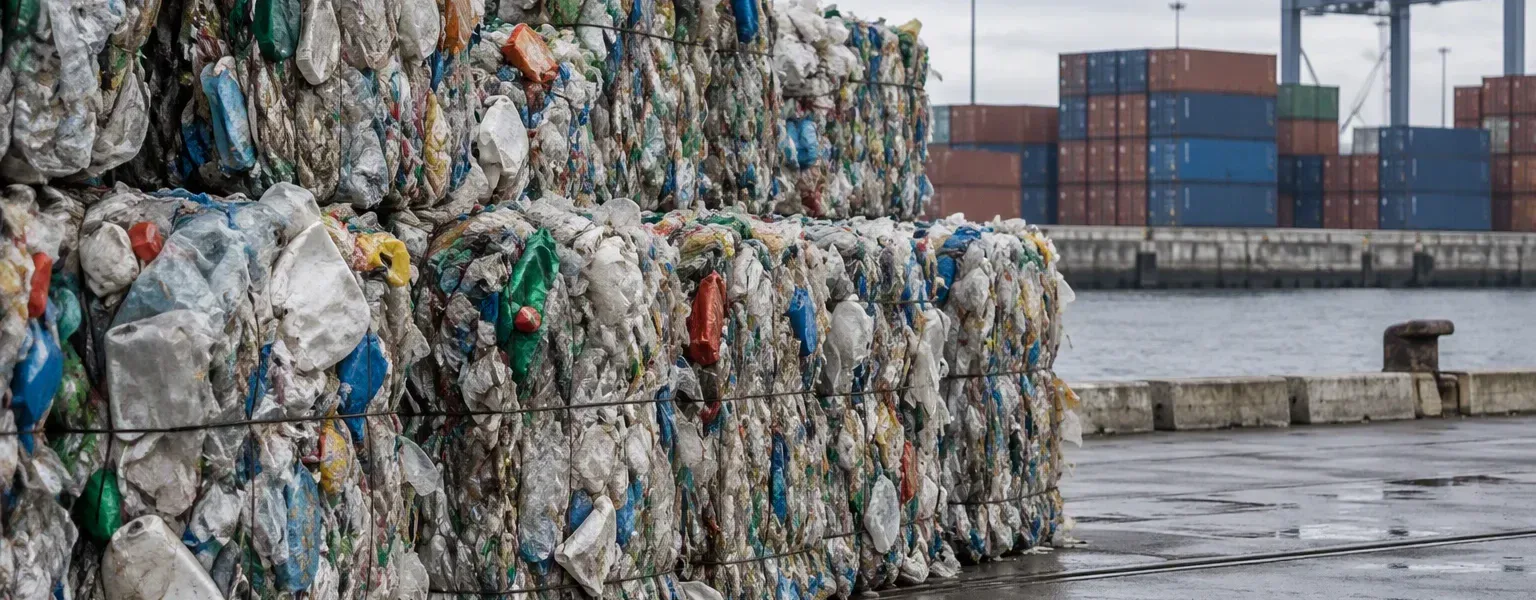
Since Friday, 21 November 2026, plastic waste can no longer leave the EU for countries outside the OECD. The plastic waste export ban comes straight from Regulation (EU) 2024/1157 on waste shipments and needs no further decision to apply. It covers non-hazardous plastic waste listed under code B3011, the entry the shipment rules use for ordinary plastic scrap, and it will last at least until May 2029. Shipments to OECD members remain legal, but since May each one has required prior written notification and consent. For sorting plants and recyclers, the ban arrives in a quiet market. In October the Bureau of International Recycling (BIR) called current conditions in Europe “bleak”, with cautious buyers and plenty of material on offer.
What changed on 21 November
Non-hazardous plastic waste under code B3011 may not be exported from the EU to any country outside the Organisation for Economic Co-operation and Development (OECD). The ban runs for at least two and a half years. Only from 21 May 2029 can a non-OECD country apply for an exemption. It will then have to show that it manages the waste in an environmentally sound way.
Exports to OECD members stay legal but are no longer routine. Since 21 May 2026 every such shipment has needed prior written notification and consent from the authorities involved. The filings run through DIWASS, the EU digital system for waste shipment notifications, which went live on the same day. We explained how it works in our May report on DIWASS and the November export ban.
Turkey is an OECD member, so the non-OECD ban does not reach it. A load bound for Turkey follows the same notification procedure as a load bound for any other OECD country.
A list for other waste streams
The second part of the regime, a list of countries, is easy to misread. Non-OECD countries that want to keep receiving other non-hazardous waste from the EU had to apply to the European Commission. The Commission confirmed the first 24 applications on 24 February 2025. They came from countries including Bangladesh, Egypt, India, Indonesia, Malaysia, Pakistan, Thailand, Vietnam and Ukraine. By September 2026, 32 countries and territories had applied.
On 18 September the Commission published a draft list, with public consultation open until 16 October. The draft admits streams such as paper, textiles, rubber, wood, glass, mineral waste and agri-food waste. Many applications for metal waste were rejected for lack of sufficient evidence of equivalent environmental and health protection. Serbia and Ukraine have specific metal entries.
The Commission was due to establish the first list by 21 November 2026. Plastics are outside its scope. The B3011 ban applies whatever the list contains, and the draft gave no one export rights ahead of adoption. The list takes full effect on 21 May 2027. From then, shipping non-hazardous waste to a non-OECD country that is not on it will be banned. The same date brings independent audits of receiving facilities under Article 46 and repeals Regulation (EC) No 1418/2007.
More material stays in Europe
Plastic waste that could once be sold to non-OECD buyers must now find a home in Europe’s own plastic recycling chain or travel to an OECD country under notification. More material will be looking for processing capacity at home, and it meets weak demand.
According to BIR’s quarterly report of 12 October, the expected post-summer recovery did not come. Recyclers had “minimal scope” to raise prices. Prices for recycled PE and PP ranged from stable to slightly lower, and higher virgin polymer prices did not lift recyclate margins. Cheaper freight added pressure. By late September, spot rates from the Far East to Northern Europe were 29% lower than on 1 July. That makes Asian recyclate and virgin resin easier to bring in.
Capacity is the other constraint. Plastics Recyclers Europe reported the loss of nearly 1 million tonnes of European recycling capacity over about three years. The 2023 base was roughly 13.2 million tonnes. The causes it named were high operating costs, weak competitiveness against virgin plastics and cheaper imports. The 2026 Plastics Europe data on circular production give the wider context. For the hardest streams, much depends on chemical recycling plants that actually operate, not on those only announced.
The calendar to 2029
The export regime and a related PET rule follow fixed dates. Five of them matter for anyone who handles plastic waste.
- 21 May 2026: plastic waste exports to OECD countries need prior written notification and consent, filed through DIWASS.
- 21 November 2026: B3011 exports to non-OECD countries are banned; the first list for other waste was due.
- 21 May 2027: other non-hazardous waste may go only to listed non-OECD countries, and receiving facilities face independent audits.
- 21 November 2027: until this date, recycled PET from outside the EU as a rule does not count towards the 25% target for PET bottles.
- 21 May 2029: non-OECD countries may apply for an exemption from the plastic waste ban.
The PET date comes from Implementing Decision (EU) 2026/1425. After November 2027, material from OECD countries may count under environmental conditions, while non-OECD material needs additional agreements. It is not an import ban, and imports stay legal.
Every bale bound for Turkey or another OECD country needs a DIWASS notification and consent before it moves. A bale for a non-OECD buyer has no legal route until at least May 2029. Contracts, storage and sales plans should assume European or OECD outlets only.
Frequently asked questions
Which plastic waste exports are banned from 21 November 2026?
Exports of non-hazardous plastic waste under code B3011 from the EU to countries outside the OECD. The ban lasts at least until 21 May 2029, when non-OECD countries may apply for an exemption.
Can European plastic waste still be shipped to Turkey?
Yes. Turkey is an OECD member, so the non-OECD ban does not apply to it. Since 21 May 2026 such shipments need prior written notification and consent, filed through DIWASS.
Does the Commission’s list of non-OECD countries cover plastics?
No. The list concerns other non-hazardous waste, such as paper, textiles or glass, and takes full effect on 21 May 2027. The plastic waste ban applies regardless of the list.